At a recent Washtenaw County Board of Commissioners meeting, an employee of Green for Life (GFL) presented the "GFL version" of the PFAS contamination that has been entering Johnson Creek since at least 2020. PFAS are long-lasting, man-made chemicals that pose significant health and environmental risks. The failure of both GFL and the previous operator of the Arbor Hills Landfill to act promptly has allowed PFAS contamination to spread within the landfill fence line, into Johnson Creek, and likely into fish caught there[1].
Please watch the three‑minute video of the comments recently made by a GFL employee at the Washtenaw County Board of Commissioners meeting and then read our commentary.
The Conservancy Initiative Commentary
GFL's Statement: Arbor Hills does not produce PFAS.
TCI Commentary: This is technically true; Arbor Hills does not manufacture anything. As the permitted landfill, however, its responsibility is to operate the facility in a way that protects community health and the surrounding environment, including preventing PFAS from entering the environment. PFAS cannot be allowed to escape the facility.
GFL's Statement: The source of PFAS entering Johnson Creek is Aqueous Film-Forming Foam (AFFF) used to extinguish a 2016 fire.
TCI Commentary: A Short-Term Stormwater Characterization Study (STSWCS)[2] required by an EGLE violation notice and commissioned by GFL did identify AFFF as a significant contributor to PFAS contamination, but it also identified additional sources. Unacceptable concentrations of PFOS were found at every inlet to the stormwater detention pond, not just at locations affected by the 2016 fire.
GFL’s Statement: The PFAS is coming from an adjacent property, not the landfill.
TCI Commentary: This is misleading and false. The fire occurred inside the Arbor Hills Landfill fence line on property that GFL purchased, and now controls, and all drainage from that area discharges to the GFL‑permitted stormwater outfall. As documented in the STSWCS, every inlet to the stormwater detention pond had PFOS concentrations above the allowable limits, including the inlets serving only the landfill. Figure 1 is a layout view of the southern portion of the Arbor Hills Landfill property and shows the location of the fire within the fenceline of Arbor Hills.
GFL’s Statement: GFL remediated the stormwater pond (Pond 3).
TCI Commentary: GLF has cleaned at least two stormwater ponds on site, but only after the PFAS and sediment-entrainment issues were highlighted to the public and reported to EGLE and the Washtenaw County Drain Commissioners' office.[3] It is unclear whether EGLE provided oversight and verified the adequacy of remediation for the large stormwater detention pond (pond 3). It is doubtful that GFL would have completed the pond cleaning without the public scrutiny.
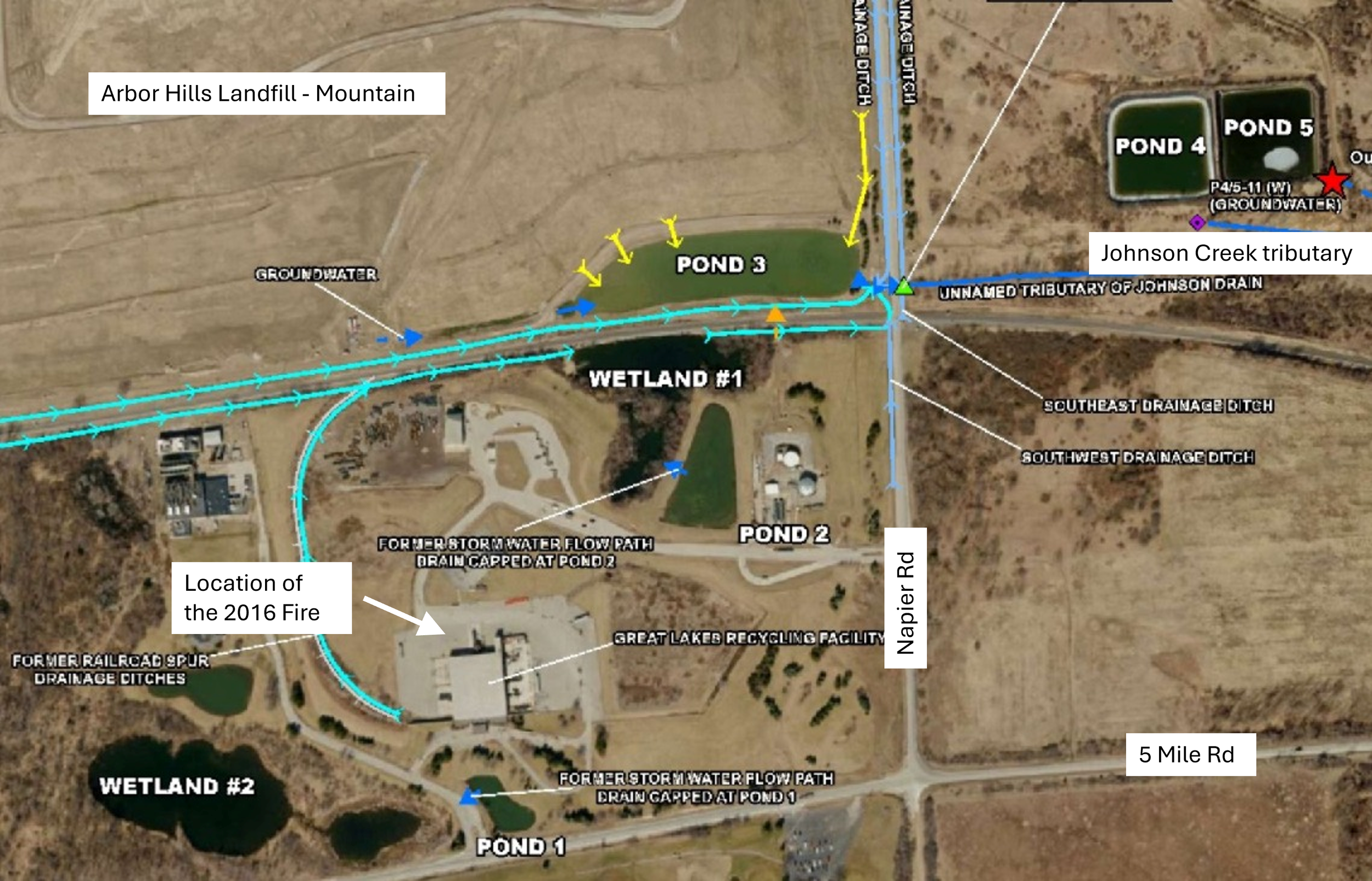
Figure 1 - AFFF used during the 2016 fire entered Pond 1, Pond 2, and likely Wetland 1. The contamination has spread to the Stormwater detention pond (Pond 3) and into Johnson Creek.
In 2021, The Conservancy Initiative discovered that PFAS from Arbor Hills was entering Johnson Creek and has repeatedly pressed EGLE and GFL for prompt corrective action. GFL has repeatedly claimed it is complying with its stormwater discharge permit[4]; EGLE does not agree and has issued a Violation Notice (VN-011821), which remains unresolved (an EGLE contact can be made available). GFL has refused to implement a transparent, publicly accessible monitoring program for its discharges and has delayed comprehensive remediation, allowing PFAS to continue spreading into Johnson Creek and the broader environment. PFAS discharges to a Johnson Creek tributary continue today.
Given this track record, The Conservancy Initiative urges the Washtenaw County Board of Commissioners to perform thorough due diligence before partnering with GFL by approving any plans for a new landfill in Salem Township.
[1] PFAS in Fish 2023 - Community-Based Study on PFAS in Fish, The Ecology Center, https://www.ecocenter.org/sites/default/files/2023-02/Fish%20Report%202023.pdf
[2] Short-Term Stormwater Characterization Study Report (PFAS), Arbor Hills Landfill, prepared by Environmental Resource Group, February 22, 2022 (page 59 of 1638)
[3] Sediment and Turbidity from Arbor Hills impacts Johnson Creek, The Conservancy Initiative, August 1, 2023
[4] GFL Letter to The Conservancy Initiative, Anthony Pellitier, GFL Vice President, July 31, 2025