In June 2026, EGLE's Air Quality Division (AQD) conducted a compliance review of air pollution regulations at the Arbor Hills Landfill. One violation notice was issued, and several troubling findings were documented. The review included a site inspection, a records review, and a Surface Emission Monitoring (SEM) survey. The SEM survey uses gas detection equipment to inspect the landfill surface and identify areas where landfill gas is leaking into the environment.
The survey information is public but difficult for most residents to access and interpret. The Conservancy Initiative is publishing this review to highlight key findings in plain English. We believe the community, including Washtenaw County leadership, must understand these findings as they consider GFL’s proposal to construct a New Landfill adjacent to the existing facility.
EGLE’s inspection shows GFL is not acting proactively to prevent odors and protect the environment. Based on the record of violations and unresolved problems, GFL has not earned the privilege to operate a New Landfill that generates millions of dollars of profit while serving as a disposal site for Canadian Trash. We plead with Washtenaw County to carefully review all the facts, talk with EGLE, and deny the requested New Landfill.
Leachate Outbreaks Entering Stormwater Collection System
The most concerning finding is likely the leachate outbreaks, where contaminated liquid percolates through the landfill cover and reaches the surface. Inspectors observed multiple outbreaks, including locations where leachate was photographed draining into the stormwater collection system, which discharges into Johnson Creek. The inspectors were from the Air Quality Division, so water and solid waste regulations were not audited. The Conservancy Initiative has forwarded the AQD report to EGLE's Water Resources Division and strongly believes leachate documented in the stormwater collection system by an EGLE inspection team should trigger a formal violation and follow‑up enforcement.
Arbor Hills is already operating with an unresolved Violation Notice for exceeding PFAS standards in stormwater discharge and failing to report those exceedances to EGLE. The leachate observed by an EGLE representative in the stormwater collection system appears to be a repeat of this pattern of noncompliance.
Surface Emission Monitoring and Community Odors
EGLE's compliance audit included a SEM survey focused on suspected problem areas near Cell 6 following recent exceedances of the methane action level at perimeter emission monitors. The SEM survey found 75 locations with surface methane concentrations greater than 500 ppm, far more than the 6 and 7 hits found during the fourth‑quarter 2025 and first‑quarter 2026 SEM surveys conducted by GFL. The SEM surveys are required to be completed quarterly and are essential to identify and repair landfill gas leaks and to prevent community odors.
In the SEM report, EGLE documented:
Arbor Hills fugitive landfill gas emissions remain sufficient in quantity and intensity to cause offsite odor concerns.
Light to some moderate levels of MSW/landfill gas odors were observed … downwind of the active area along Six Mile. Several moderate to locally strong pockets of landfill gas/ H2S type odors were encountered during the SEM inspection in the vicinity of SEM hits. Also, some locally strong odors were noted downwind and uphill of two frac tanks on the south side of the landfill.
In September 2024, USEPA issued an Enforcement Alert reminding landfill operators of their obligations to properly conduct SEM surveys after finding widespread noncompliance, which closely parallels EGLE's observations at Arbor Hills. This federal alert underscores that the problems at Arbor Hills are part of a broader pattern of inadequate landfill gas monitoring and maintenance.
Landfill Cover
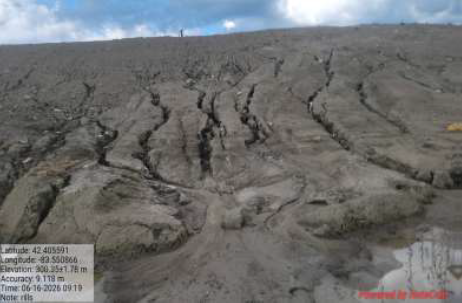
The landfill cover must be inspected and properly maintained to prevent landfill gas from leaking into the environment. The EGLE inspection team detected landfill gas leaks in areas where deep erosion rills were observed. The inspectors reviewed historic aerial photographs and determined:
… widespread areas of the landfill where rill fields are present in April 2026. Review of 2025 aerial photographs showed that many of the same erosion rills present in 2025 were still present in 2026.
Gas Collection and Control System gas wells
Liquid and sediment in the gas wells continues to impair gas collection; in simple terms, leachate has accumulated and is blocking the area where gas should flow.
Approximately 50% of the vertical wells appear to be impaired by liquid. SEM hits were documented collocated with the areas of the landfill that have concentrated areas of wells that are impaired by liquid. The liquid impairment is causing reduced ROI’s and gaps in coverage.
Excess liquid in the landfill is a well-documented issue at this landfill and has led to significant gas collection impairment, SEM hits, and likely has contributed to offsite underground migration of methane.
Flare Emission Testing
Air pollution regulations typically require periodic performance testing of control equipment such as flares. During the records review, EGLE found that GFL failed to commission and complete a required emission test on one landfill flare. EGLE issued a Violation Notice directing GFL to complete the test and implement measures to ensure future testing is conducted in a timely manner.
Our Conclusions
This failure to perform basic performance testing, combined with impaired gas wells, repeated SEM hits, persistent odors, and leachate reaching the stormwater system, paints a clear picture: Arbor Hills is not being managed in a way that protects neighboring communities and the environment. Until existing violations are resolved and underlying problems are corrected, GFL should not be entrusted with constructing or operating a New Landfill in Washtenaw County.
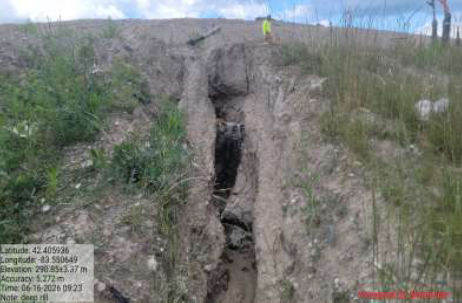
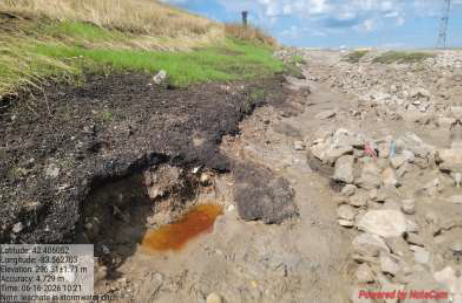
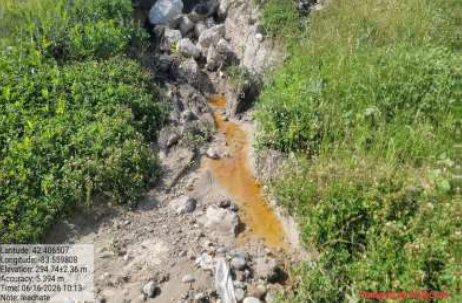
Images of errosion rills and leachate breakouts