The landfill business in Southeast Michigan is highly competitive, with facilities operating across the region. To provide clarity, The Conservancy Initiative conducted a study to estimate future regional landfill capacity under realistic assumptions. The study aims to help the Washtenaw Materials Management Planning Committee and other regional stakeholders assess whether new landfill capacity is needed.
The predictive modeling shows that Southeast Michigan currently maintains over 20 years of landfill capacity[i], with at least 13 years remaining at the end of FY2033. You can review our full analysis by downloading the report’s Executive Summary or access the interactive tool, created by Arbor Hills Monitor.org, which uses our assumptions to test custom regional waste scenarios. [The interactive tool is best viewed using a computer].
When evaluating regional waste management, the data show ample landfill capacity and no reason to rush approval for a new landfill, a decision that would permanently cement a dubious environmental legacy.
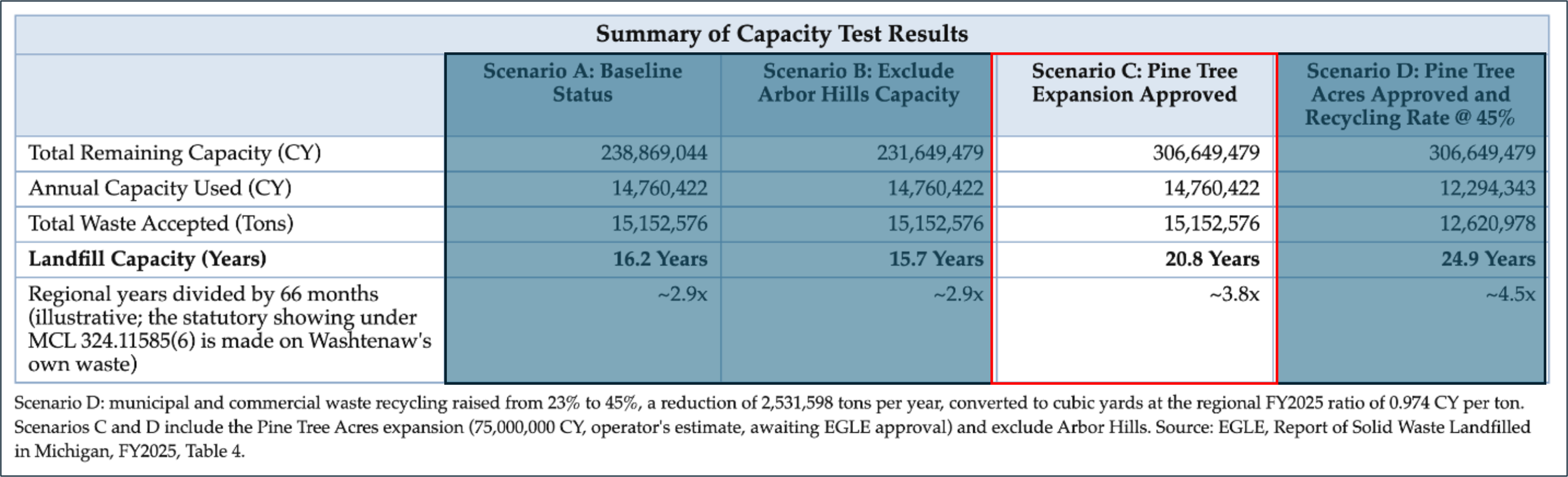
Figure 1 - Summary of Landfill Capacity Study - Scenario C is the most likely scenario. This scenario includes recently approved landfill capacity at the McGill Road landfill and capacity awaiting approval at the Pine Tree Acres landfill
The Case Against Redundant Capacity
Under the most realistic operational outlook (scenario C), which includes approved landfill capacity at the McGill Road landfill and pending expansion at the Pine Tree Acres landfill, Southeast Michigan has more than two decades of capacity. Plans for additional landfill expansions in the region are anticipated, but not included in this study. Because the Materials Management Planning (MMP) process is continuous, Washtenaw County can modify its plan down the road if a genuine need ever arises.
The interactive landfill capacity tool, created by Arbor Hills Monitor.org, allows the MMP committee and regional planners to run real-world "what-if" scenarios, measuring how shifting Canadian waste imports, rising recycling rates, or facility closures impact regional disposal dynamics. The model uses data provided by landfill operators and reported to the public in EGLE's annual Report of Solid Waste Landfilled in Michigan. The interactive tool can be modified to provide insight into additional operating scenarios.
Approving unneeded capacity carries severe environmental costs. Michigan currently leads the nation in per-capita trash disposal, and maintaining excess landfill space only invites out-of-state waste imports while undermining local recycling and reuse investments. The MMP Committee and Washtenaw County Board of Commissioners have heard from GFL, Arbor Hill's owner. They must now consult established environmental leaders—including the Ecology Center, Sierra Club, and Zero Waste Coalition of Ann Arbor—to safeguard Washtenaw County's commitment to sustainability.
[i] Includes the recently approved expansion (781,000 cu yards) at the McGill Road landfill and assumes a proposed expansion (75,000,000 cu yards) at the Pine Tree Acres landfill gains approval